Home
Pricing
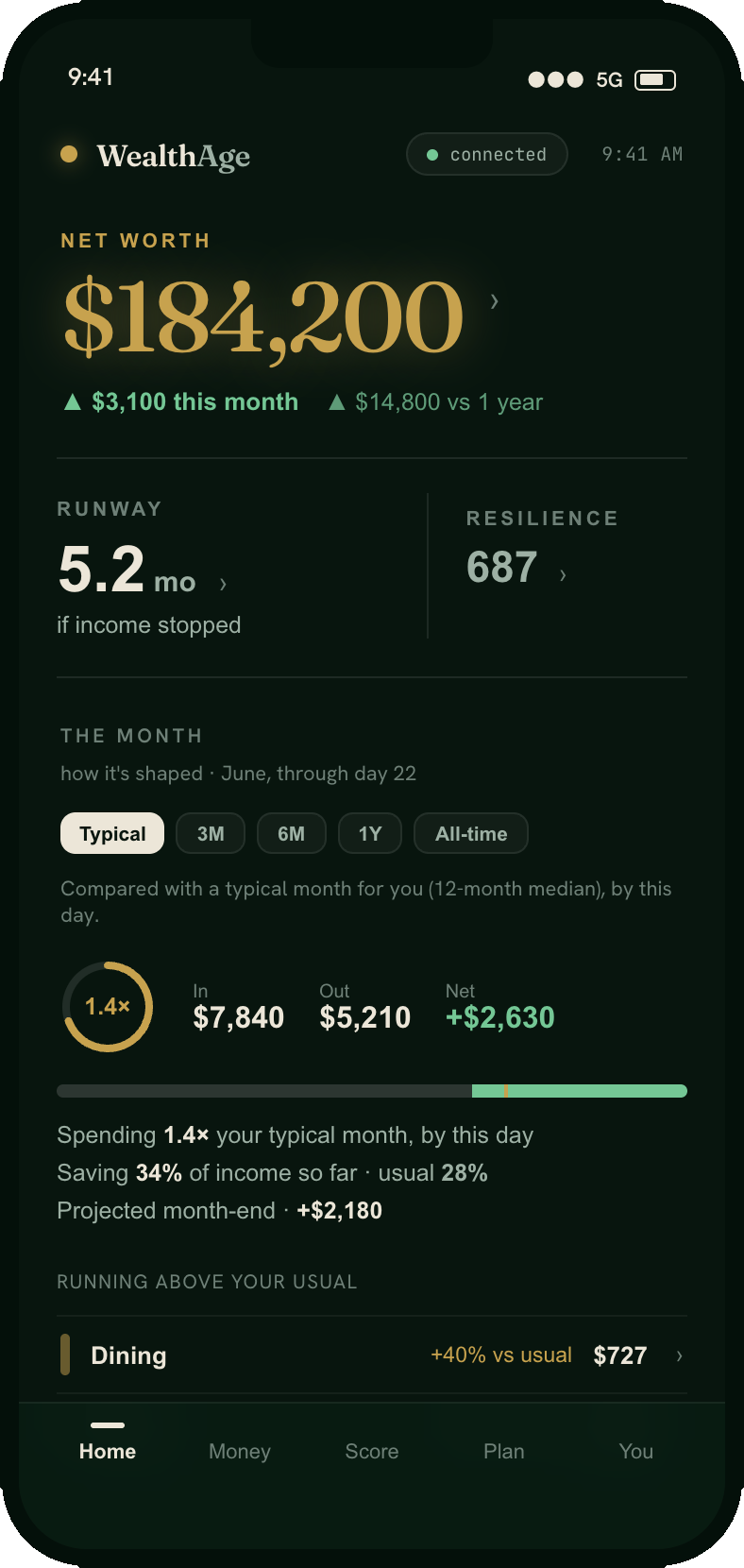
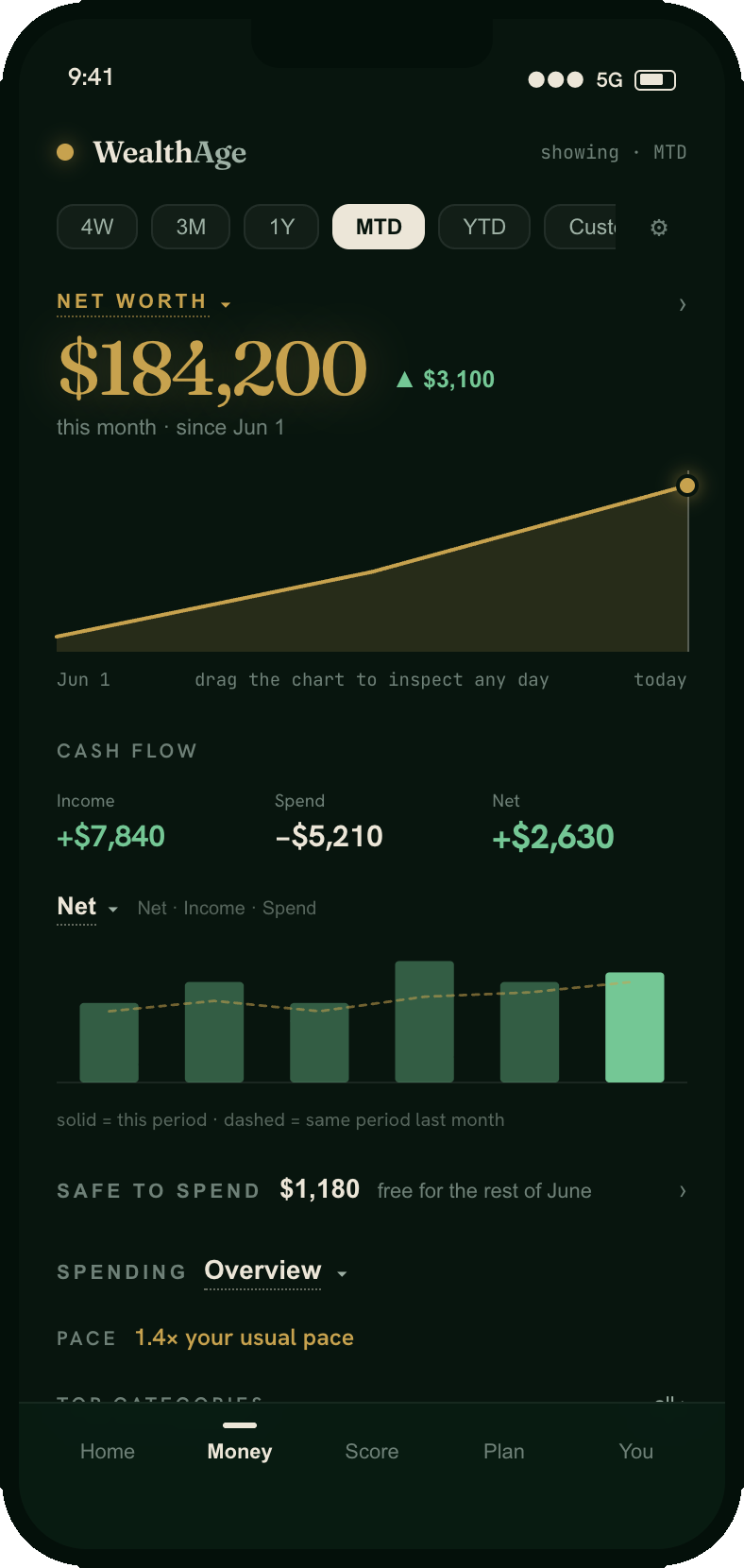
WealthAge is the complete personal finance app for financial resilience, sold as one plan: accounts, transactions, spending, cash flow, net worth, investments and recurring charges in one place, kept traceable to where they came from. You can look first for free, with no bank login and no card.
$10.75 a month, billed $129 a year. Or $14.99 a month, billed monthly.
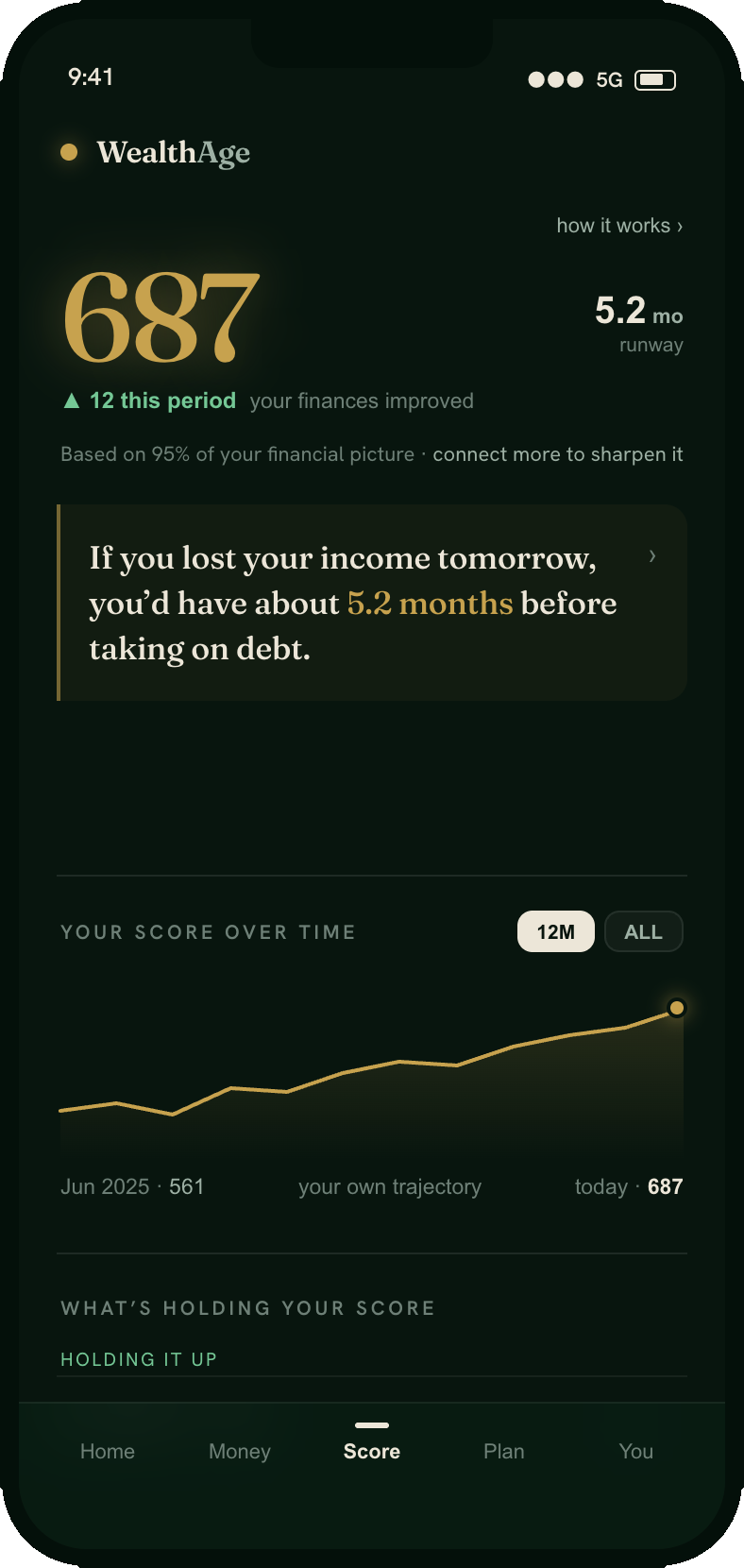
Every view below is in the one plan.
Home
Money
Score
Plan and You are on the roadmap, and the price does not wait on them.
That is the app. The rest of this page is what it costs, and why.
The money question
Because a free one has to get paid some other way, and every other way points the product at someone who is not you. A paid app has one customer: you.
Your subscription is our only revenue. It pays for sync quality, the published method, and the work of keeping both current. No ads, and we never sell your financial data. The price is the proof.
That is the case for paying at all. What the money buys is a standard, and this is what it looks like.
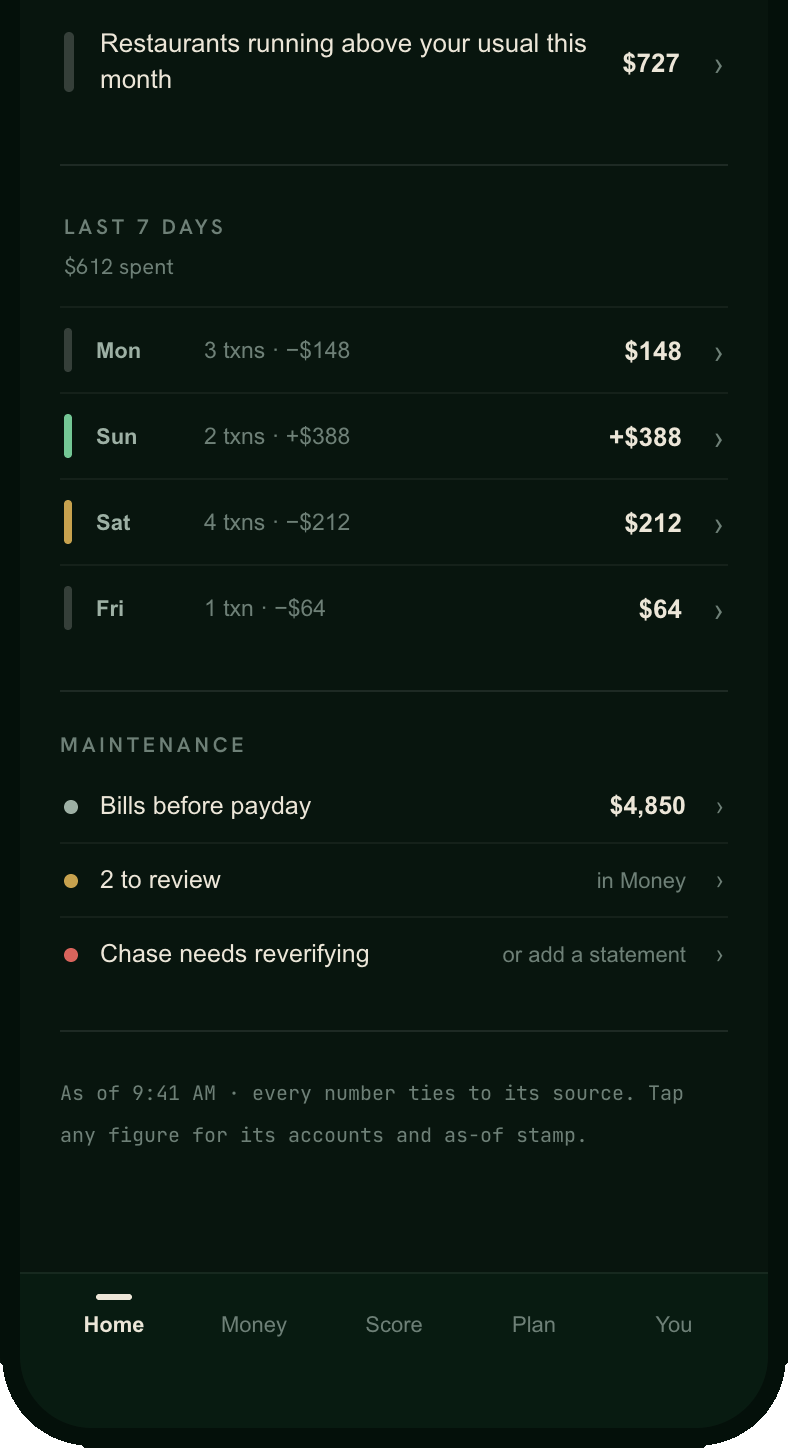
Provenance
When a connection breaks, the screen says so, instead of leaving a number that still looks fine.
That is the product. What it costs is next.
The plan
Your WealthAge Resilience Score, with the reasons shown what is holding it up, and what is pulling it down.
Net worth, spending and cash flow in one place, with full history.
Two ways in connect accounts read-only, upload files, or both.
Your export, any day one click, including the day you leave.
WealthAge, complete
$10.75 a month
Billed $129 a year.
Prefer monthly: $14.99 a month, billed monthly.
No feature tiers, no discounts.
The free tools below are the look inside.
All three leaders read live 2026-08-08. Monthly figures: the annual list price divided by twelve, before any first-year promotion; with its public code, Monarch's first year is about $70.
Monarch Money and Copilot Money do the ordinary work well, and their prices are honest for what they sell. Ours is the highest of the four, on purpose. The next section is what the difference pays for.
Proof
The category proves itself with review stars, and those reviews are real. What a rating cannot tell you is whether the numbers behind it hold up.
U.S. Census Bureau Survey of Income and Program Participation, 24,162 households, 2022 finances against 2023 outcomes. Measured as AUC: 0.640 for the rule of thumb, 0.717 for the model, on held-out households. Research about a population, never a ranking of you.
The method is readable before you pay, and so is the arithmetic, on numbers you type yourself.
Look before you buy
Two tools are free: the savings runway calculator, complete rather than a teaser, and the resilience score estimator, which returns an estimate from six inputs rather than the full-picture score. No bank login, no card. A free account at the end saves your result.
The questions that come next are the ones about leaving.
Questions
You cancel from inside the app, and you can export your complete history any day, in one click, including the day you leave. Your numbers arrived as yours and they leave as yours.
Yes. The free stress test and the two free calculators show the method working on numbers you type yourself, and a free account at the end saves your result.
No. Uploads are a first-class path, not a fallback. Connect a supported institution, upload your own files, or both. On either path, figures carry their source and the time they were last confirmed.
Only in how you pay. One plan, every feature, both ways. There are no tiers and no discounts.
$129 once a year, which works out to $10.75 a month, or $14.99 a month billed monthly. If you stay longer than nine months, annual costs less.
One tradeoff remains, and it is stated plainly below.
WealthAge is newer than the apps above and costs more. What the price buys that theirs does not: the answer to how long your money would last, on a method you can read first. If you want the cheapest tracker, one of the apps above is the better buy.
WealthAge is not a financial advisor; the score describes, it does not prescribe.