The personal finance apps, compared
WealthAge vs Monarch Money: how long would your money last?
Monarch Money is a good personal finance app: accounts, transactions, spending, net worth and investments in one place, and it does that work well. WealthAge matches the tracking work, ties figures to their source and the time they were confirmed, and then answers what a dashboard cannot: how long your money would last if your income stopped.
Monarch read live 2026-08-08
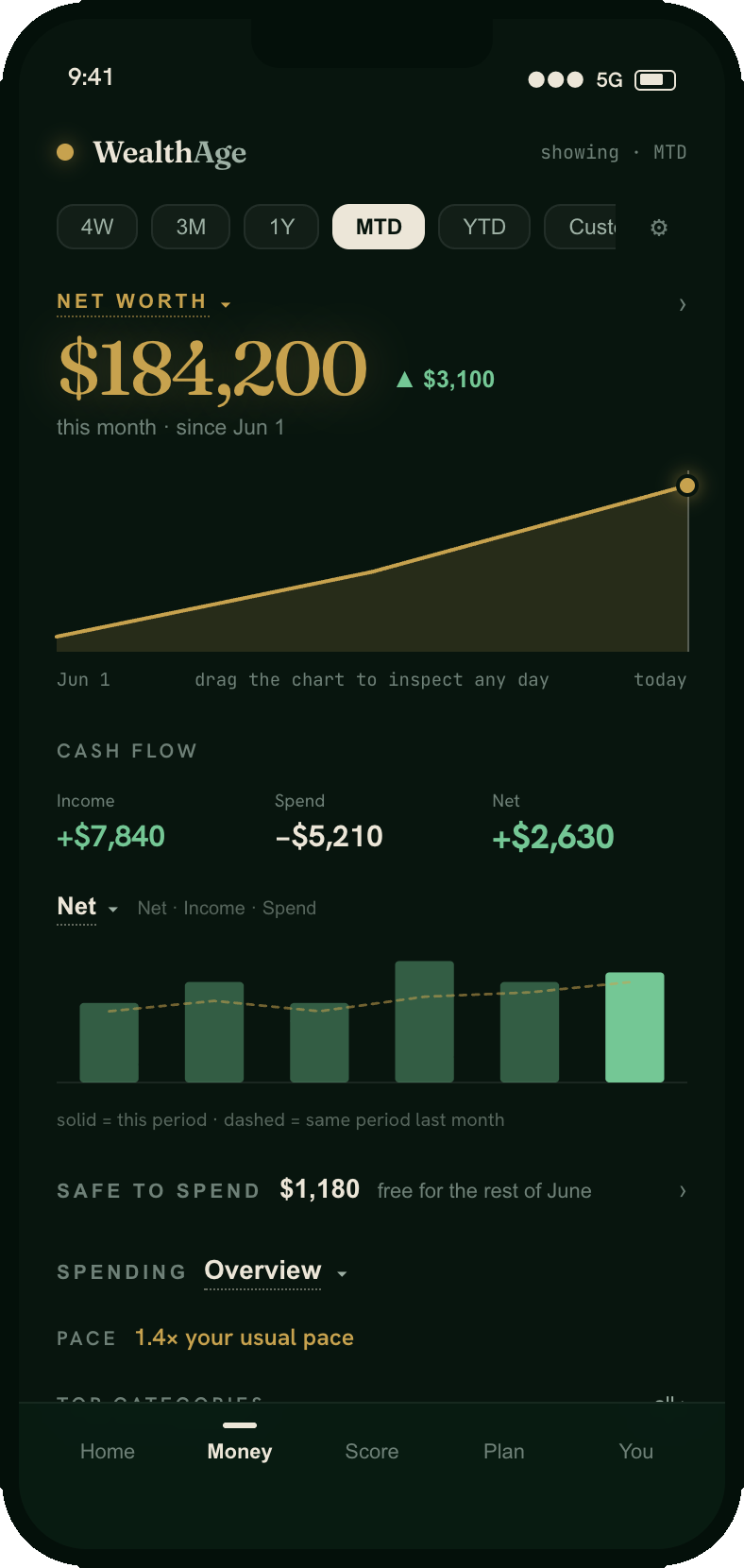
Start where both apps agree, because a switch that costs you the basics is not a switch.
Side by side
If you already pay for a money app, the only question is what you gain and what you give up.
Both personal finance apps do the ordinary work, and the first four rows prove it.
Four rows of parity come first. The rows Monarch wins stay on the page, dated like every other cell.
Monarch cells read from monarch.com on 2026-08-08: its pricing page, its features pages and its trust page. Not stated means we found no such claim on the pages we read that day, not that Monarch cannot do it. One cell carries an earlier read, shown in the cell: manual accounts and CSV import (2026-08-05). The settings-export date in the migration steps below is from our 2026-08-03 read. Tell us if a fact is stale and we will fix it.
One more dated fact. Monarch’s own comparison pages, read 2026-08-08, cover Mint, YNAB, Simplifi and Credit Karma; none shows a dated verification and none shows a row Monarch loses. This page carries both, and that difference in method is the one you can check right now.
Two of those rows are Monarch’s to win, and they are worth more than a checkmark.
Where Monarch wins
The trade is four real advantages against one answer.
Price The Plus plan is $8.33 a month billed $99.99 annually, or $14.99 month to month, with a 7-day free trial and a 30% first-year code running site-wide, read live 2026-08-08.
A phone app An app to download for your phone today; WealthAge is web today, with native apps on the roadmap.
Couples A couples experience at the top of its navigation; WealthAge is built around one household login.
The press shelf Its home page carried CNBC, Forbes and Wall Street Journal laurels at our 2026-08-05 read. WealthAge has no third-party reviews yet.
WealthAge is $129 a year, or $14.99 a month: $29 a year more than Monarch at list, and more still against its first-year code. If price, a phone app, or shared money management decides it, Monarch is the better buy today.
That is the honest ledger. What the difference buys comes next.
The difference
A clean dashboard still cannot tell you whether the whole thing would hold.
How is WealthAge different?
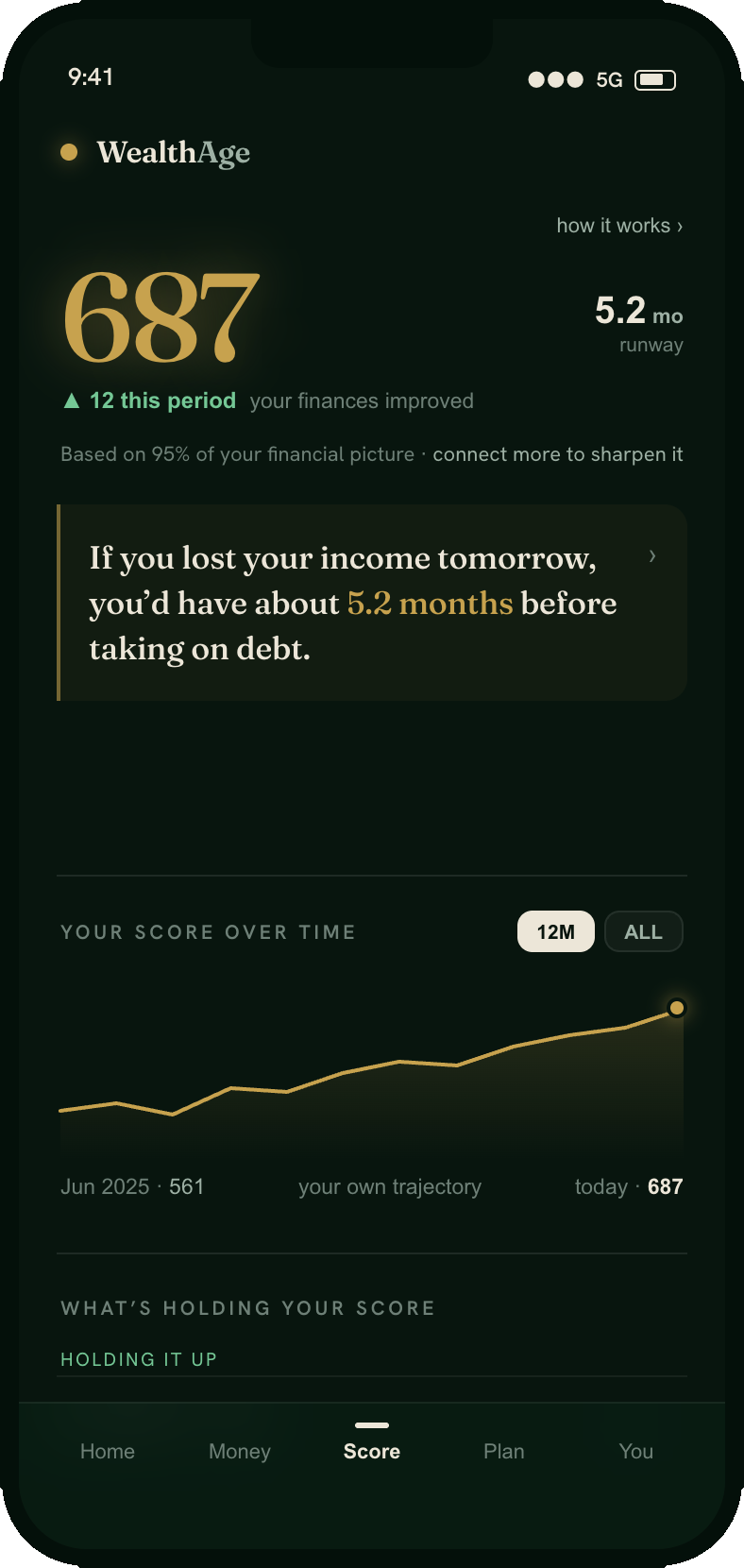
If your income stopped tomorrow, this household would have about 5.2 months before taking on debt. That is the WealthAge Resilience Score at work. It simulates a shock against your real money: what you could actually access, what keeps draining, and what would replace your income. Runway weighs heaviest, and a strength in one place cannot average away insolvency in another. One of our published fixtures takes home $18,000 a month and scores 422; income is not resilience. Behind it sits the standard the table showed: figures carry their source and the time they were confirmed, and the method is published with its limits.
- The score
- 687
- Runway behind it
- 5.2 months
- Coverage when computed
- 95% of the picture
Example households from our published fixtures, not real users. Your WealthAge score is never a ranking of you against other people.
On 24,162 households, this model predicted hardship better than the months-of-expenses rule.
- Months-of-expenses rule of thumb
- 64.0%
- The WealthAge model
- 71.7%
The test: take two households, one that later hit the hardship outcome and one that did not, and see how often each method ranks them in the right order. U.S. Census Bureau Survey of Income and Program Participation, 24,162 households, 2022 finances against 2023 outcomes. Measured as AUC: 0.640 for the rule of thumb, 0.717 for the model, on held-out households. Research about a population, never a ranking of you.
If the answer is worth the difference, the move itself is the last question.
The migration
Switching from Monarch Money takes an afternoon.
1 · Export from Monarch Money Export your data from the Monarch settings screen (confirmed at our 2026-08-03 read), or download statements from your banks directly. Either way you end with files you own.
2 · Upload into WealthAge Upload the files: csv, ofx, qfx, xlsx or a pdf statement, no bank login needed. Every imported row keeps the file it came from and its exact place in that file. If a file does not parse, we tell you exactly which rows failed and why.
3 · Reconnect what you want live Connect a supported institution through Plaid, read-only, and it refreshes on its own. Or stay on uploads; both paths enter the same system and produce the same views and the same score.
Three things do not come with you.
The budgets, rules and goals you built in Monarch do not arrive as rules. Your transactions arrive as data; categories are set here, and a correction sticks from then on, back through your history.
Bank connections do not carry over. A connection belongs to the app that made it, so you reconnect here or keep uploading files.
Your Monarch subscription does not cancel itself. Cancel it with Monarch when you are ready; your exported file is yours either way.
The rest is what switchers actually ask.
Questions
What do people ask before leaving Monarch?
Can I import my Monarch Money data into WealthAge?
Yes. Export your data from Monarch as a file, or download statements from your banks, then upload it here: csv, ofx, qfx, xlsx or pdf, no bank login needed. Every imported row keeps the file it came from and its place in it. If a file does not parse, we tell you exactly which rows failed and why.
Is WealthAge more expensive than Monarch Money?
On the annual plan, yes. The Monarch Plus plan is $99.99 a year against $129 for WealthAge, a $29 difference, read live 2026-08-08; month to month both are $14.99. The difference pays for the resilience layer: figures that carry their source, a published method, and the answer to how long your money would last. If you want the cheapest tracker, Monarch is the better buy.
Is WealthAge better than Monarch Money for couples?
No. Monarch puts a couples experience at the top of its navigation, and WealthAge is built around one household login today. If two people running money together in one app decides it, Monarch is the better buy.
Is WealthAge a good Monarch Money alternative?
That depends on the deciding question. If the cheapest tracker, a phone app today, or a couples setup decides it, Monarch is the better buy, and this page says so. If the deciding question is how long your money would last if income stopped, that answer is the one WealthAge is built around, and the tradeoffs are dated above.
Do I have to connect my bank to try WealthAge?
No. Uploads are a first-class path, not a fallback: an uploaded statement and a live connection enter the same system and produce the same views and the same score. Only a connection refreshes on its own.
Can I see WealthAge before switching?
Yes. The free stress test asks six questions and returns an estimate of the how-long answer, computed from what you enter rather than from your full picture. No bank login, no card, and a free account at the end saves your result.
One limit remains, and it is named below.
Other money apps help you see what happened. WealthAge helps you know what happens next.
One limit, stated plainly: WealthAge can only see what you connect or upload; an account you never bring in is not in your answer. Web today, built for your phone’s browser, with native apps on the roadmap. If Monarch’s four advantages above decide it for you, take them. If the deciding question is how long your money would last, that answer is the one this app was built around.
WealthAge is $129 a year, or $14.99 a month.
WealthAge is not a financial advisor; the score describes, it does not prescribe. It is informational and yours: not a credit score, consumer report or lending input.