How it works
See how the money app works, step by step.
Your money picture runs on numbers you take on trust. Monarch and Copilot both do the finished dashboard well, and WealthAge starts by matching that work.
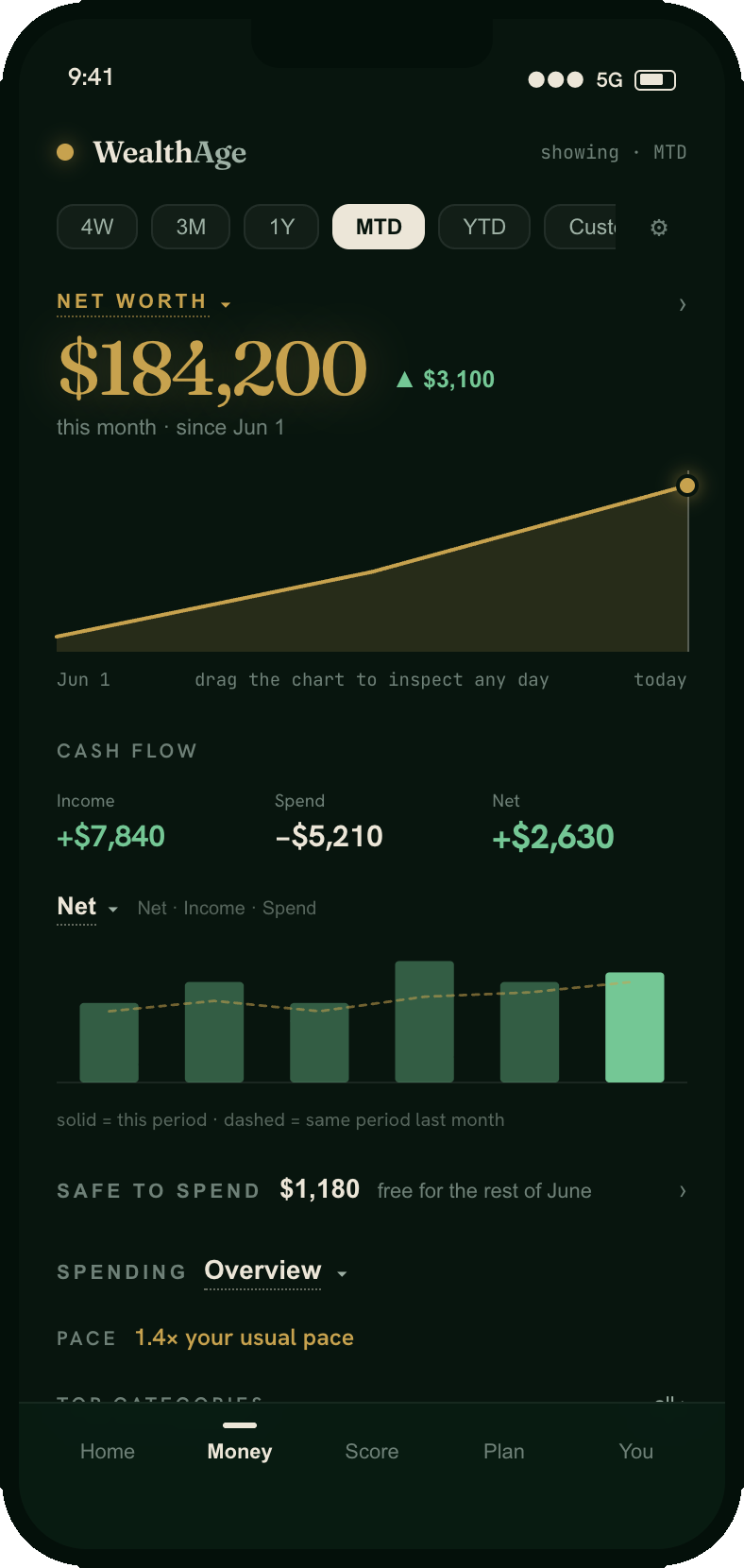
WealthAge is a personal finance app, and it works in four steps. Your accounts, transactions, spending, cash flow and net worth land in one place, connected or uploaded. This month shows against your own typical month. Every figure keeps its source, your corrections hold, and then it tells you how long your money would last if your income stopped.
This page walks the four steps in order, on the product itself, so you can check the work instead of taking it on trust.
01 Bring it together · 02 See where it goes · 03 Kept true · 04 The answer out · Then, prepare
01 · Bring it together
Your money sits behind five or six logins, and no one screen has all of it.
Connect your accounts, or upload your files. The money app assembles all of it in one place.
A connection is read-only, made through Plaid, a regulated aggregator, and it refreshes on its own. An upload (csv, ofx, qfx, xlsx, or a pdf statement) enters the same system and produces the same product, and every imported row keeps the file it came from and its place in it. Neither path is a fallback, and you can run both at once.
The point is what the place shows you.
02 · See where it goes
A budget you invented in January knows nothing about the month you are actually having.
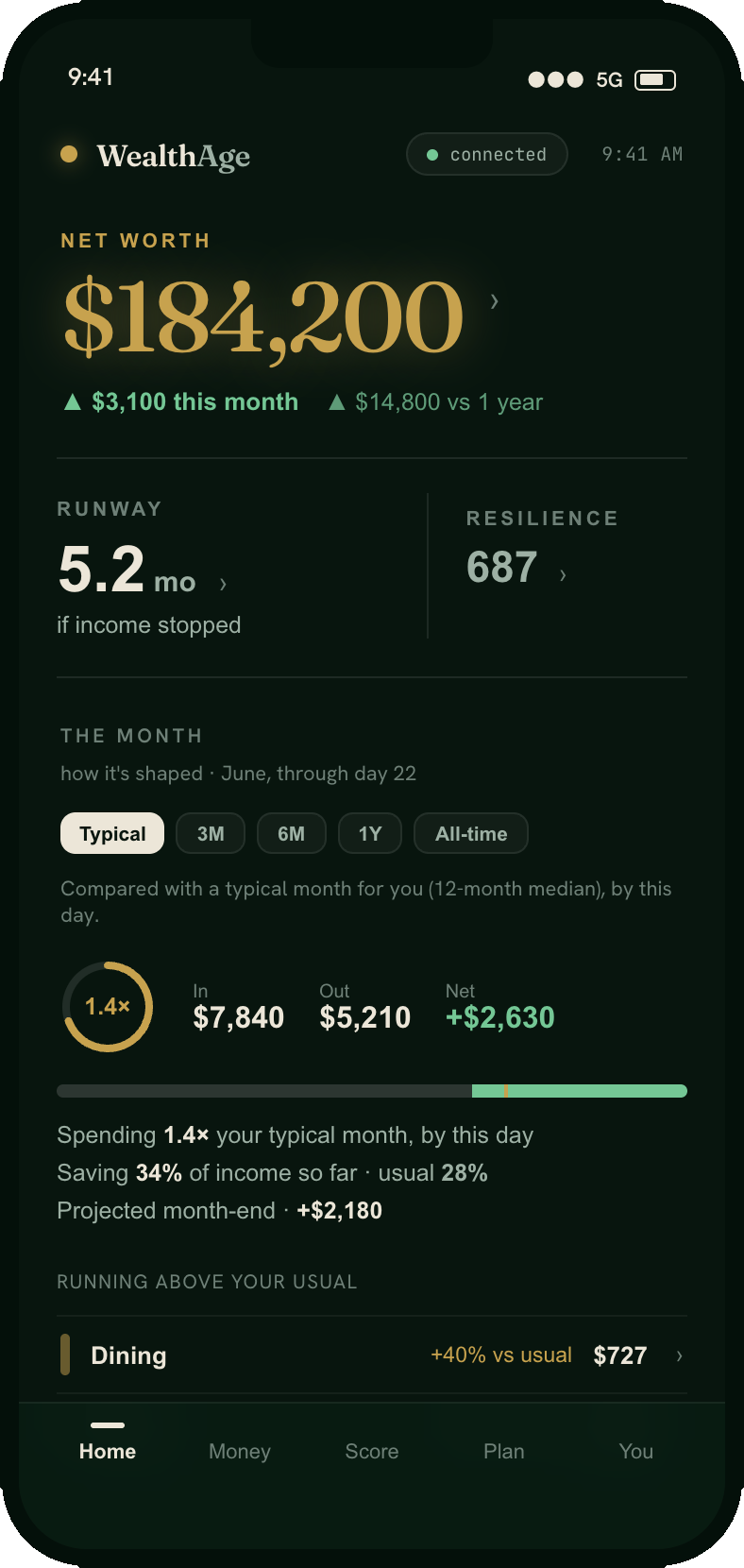
It shows where the money goes, against a typical month of your own.
Spending, cash flow and net worth sit in one set of numbers, categorized. WealthAge compares this month with a typical month of your own, by this day: income, spend, net, and what is safe to spend for the rest of the month.
All of which is worth exactly as much as the numbers underneath it.
03 · Kept true
A sync breaks silently, and you read last month’s balance as if it were today’s.
Every figure holds to its source, and your corrections stick.
Every number names its source and the moment it was last confirmed. When a connection breaks, the screen says so and tells you how to fix it, instead of leaving you a number that still looks fine. And when a category is wrong, you correct it once. The rule sticks and reaches back through your history, so the same merchant is right from then on, and in the past too.
Once the figures hold, the harder question becomes fair to ask.
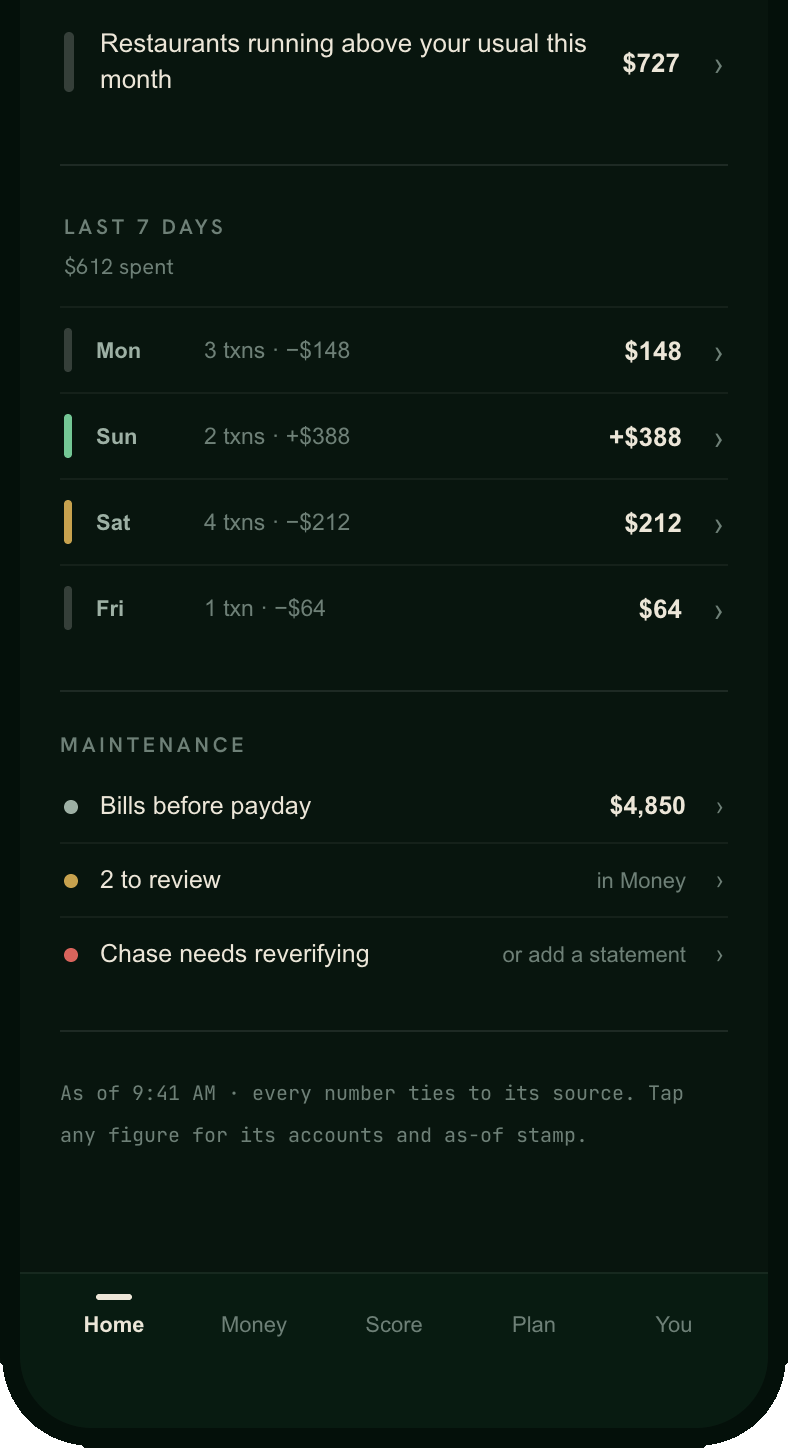
Three steps in, you have a money app whose numbers you can check. The fourth step is the one this page is really about.
Get WealthAge04 · The answer out
Even with a clean dashboard, you still cannot tell whether the whole thing would hold.
Then the picture answers the question the dashboard cannot.
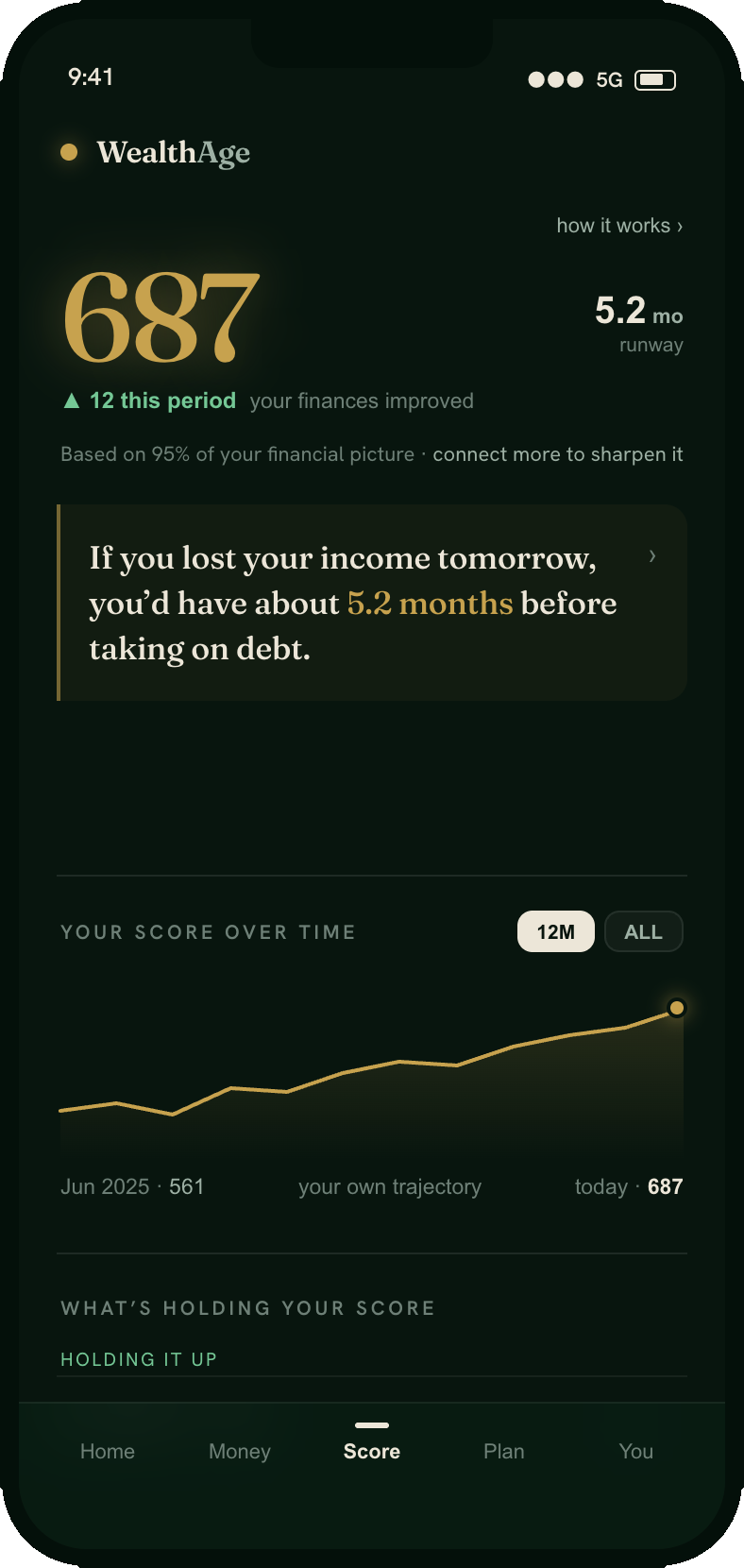
If your income stopped tomorrow, this household would have about 5.2 months before taking on debt. That sentence is the WealthAge Resilience Score at work. It simulates a shock against the real money the first three steps assembled: what you could actually access, what keeps draining, and what would replace your income. Runway weighs heaviest, and a strength in one place cannot average away insolvency in another.
- The score
- 687
- Runway behind it
- 5.2 months
- Coverage when computed
- 95% of the picture
- Accounts confirmed
- 9 of 10, today
An example household, not a real user. We never rank you against anybody else.
On 24,162 households, this model predicted hardship better than the months-of-expenses rule.
- Months-of-expenses rule of thumb
- 64.0%
- The WealthAge model
- 71.7%
The test: take two households, one that later hit the hardship outcome and one that did not, and see how often each method ranks them in the right order. U.S. Census Bureau Survey of Income and Program Participation, 24,162 households, 2022 finances against 2023 outcomes. Research about a population, never a ranking of you.
WealthAge is not a financial advisor; the score describes, it does not prescribe. And a number that flatters you is worthless the day it disagrees with you, which is why the method is published with its limits.
That is the mechanism, end to end. What is left is what you do with the answer.
Then · Prepare
Big changes get decided on a guess about whether the money can take it.
Price a real change before you make it.
Before you commit to a change, WealthAge prices it against your actual numbers and shows what it does to your runway and your time to financial independence. Consequence facts. You decide. Nothing here tells you what to do.
Everything above runs on your own numbers the day you bring them in.
Get WealthAgeAnd you can see the shape of the answer before you connect anything at all.
Also free
The calculators are free and complete, and they are not the product.
The free stress test asks six questions and returns an estimate of the how-long answer, computed from what you enter rather than from your full picture. No bank login, no card. A free account at the end saves your score. The savings runway tool answers a narrower question the same way, and both sit on the tools page.
Whichever you try first, the same questions tend to come up next.
Questions
Five questions come up at this point.
How does WealthAge work?
In four steps. You connect accounts or upload files, and everything lands in one place. It shows where the money goes against a typical month of your own. Every figure keeps its source and your corrections hold. Then it simulates a shock and tells you how long your money would last.
Do I have to connect a bank account?
No. Connecting through Plaid, a regulated aggregator, is the fastest path and it is read-only, but uploading a file works just as well: csv, ofx, qfx, xlsx or a pdf statement. Every row keeps the file it came from and its exact place in that file, so any number can be traced back to where it came from.
What happens when a category is wrong?
Correct it once. The rule sticks and reaches back through your history, so the same merchant is right from then on and in the past too.
What does the WealthAge Resilience Score add?
It answers how long you would last if your income stopped. It only knows the accounts you bring in, so adding one more can move it.
Do the four steps have to happen in order?
They build on each other, but you can stop after any of them. The dashboard works without ever opening your score, and one uploaded statement is enough to start. The more of your picture WealthAge can see, the more each step covers.
Each answer here is the short version. The long versions live on their own pages.
Keep going
Every claim on this page has a page behind it.
The five views, one at a time, on the real screens.
What goes in, why, and how well it predicts, with the validation shown.
Row by row, verified and dated.
Other money apps help you see what happened. WealthAge helps you know what happens next.
WealthAge can only see what you connect or upload. An account you never bring in is not in your picture, and not in your answer. Web today, built for your phone’s browser. Native apps are on the roadmap, and this page will carry the links the day they ship.